Our quest for the perfect data model
Find out how we help companies and organizations to gain valuable insights and profit from out data science expertise.
Cases
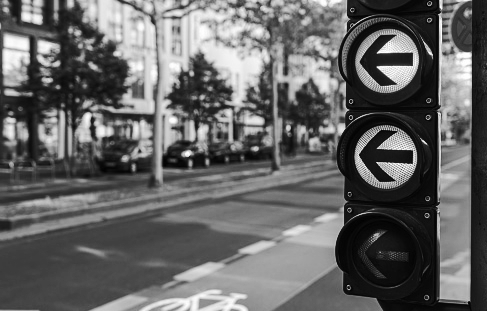
The traffic light model
Determining the dwell time
A lot has changed in the world of out-of-home advertising: digital screens suddenly began appearing on the streets. And with them came the question of how many passersby can actually see a spot on these screens. To calculate this, there is the so-called “spot formula,” which uses the length of time spent within the spots field of view as its most important parameter. We wanted to calculate this not only for standard street sections (which is easy) but also for screens at intersections, where there are many situations where people are waiting.
The ISBA traffic light model determines the length of time vehicles spend within the screen’s field of view based on the road network, the positions and cycle times of the traffic lights, and vehicle movements around a screen location. The trajectory of each vehicle at the intersection is derived as the solution to a differential equation that translates changes in distance from the vehicle ahead into acceleration or braking. A central concept here is the “comfortable following distance”: Sometimes traffic flows smoothly because the distance to the vehicle ahead remains comfortably large; at other times, drivers inevitably become more cautious when this distance shrinks and they must adjust their speed. By analyzing the resulting overall system, the desired dwell time can ultimately be determined.
Let’s talk
We may not know each other yet. But that could change. Please get in touch; we look forward to a fruitful discussion about data, structures, markets and projects.
 English
  German